

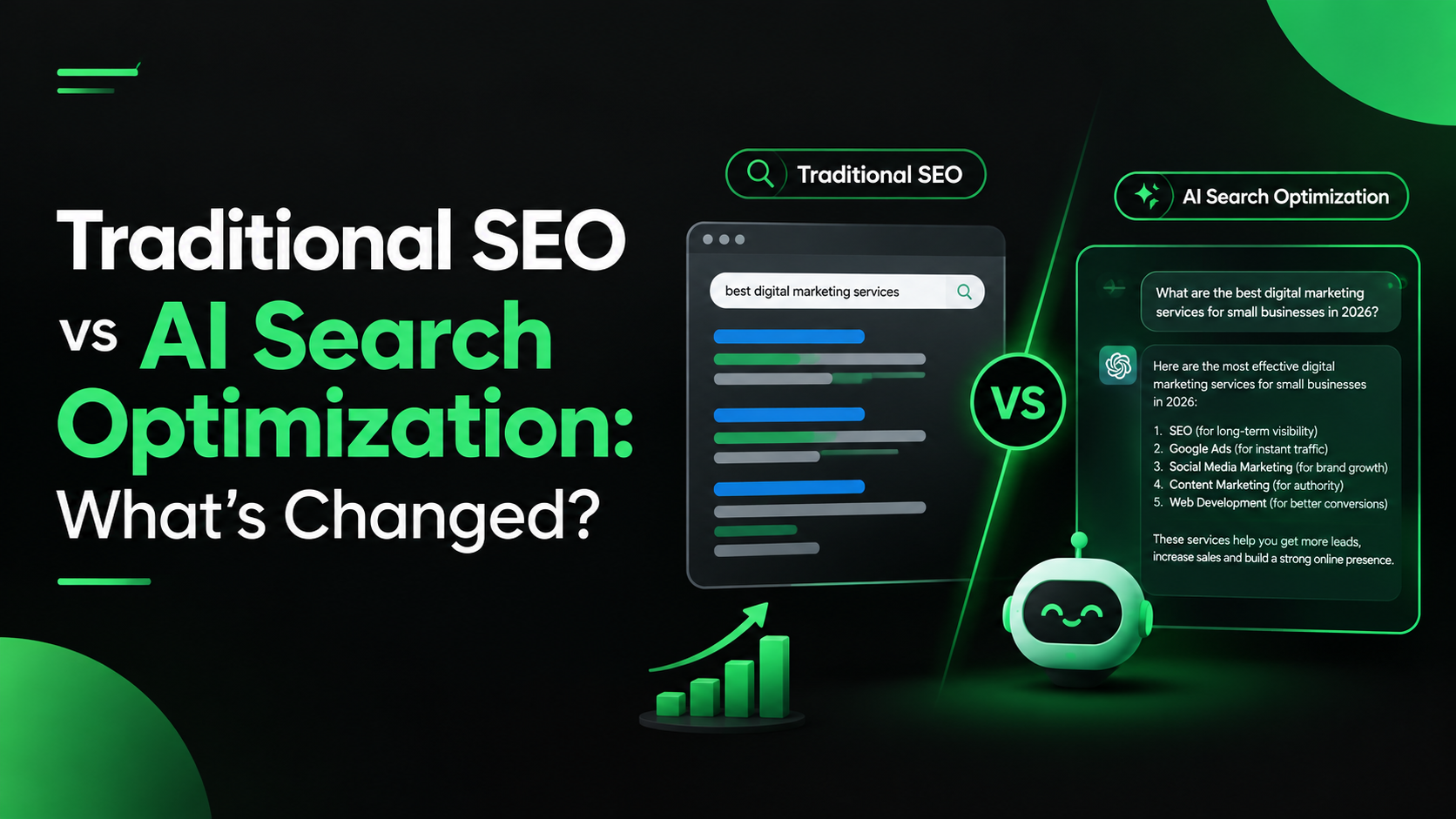
Traditional SEO vs AI Search Optimization: What's Changed?
For two decades, the goal of search engine optimization was simple to describe even if it was hard to execute. Rank on page one of Google, ideally in the top three positions, and the traffic would follow. That single objective shaped an entire industry built around keywords, backlinks, and technical fixes. But the way people find information has started to shift in a way that is forcing marketers to rethink that playbook. Search engines increasingly answer questions directly, often before a user ever clicks a link, and AI tools like ChatGPT, Perplexity, and Gemini have become genuine research destinations rather than novelty chatbots. This raises a real question for anyone doing marketing today: has traditional SEO become obsolete, or has it simply evolved into something broader? The honest answer is a bit of both, and understanding the difference matters for anyone trying to stay visible online.
What Traditional SEO Actually Optimized For
Traditional SEO was built around a few core pillars. Keyword research identified the exact terms people typed into a search box, and content was written to match those terms as closely as possible, sometimes to the point of overdoing it. On page elements like title tags, meta descriptions, and header structure told search engines what a page was about. Backlinks from other websites acted as votes of confidence, and the more authoritative the linking site, the more that vote counted toward a page's ranking. Technical factors like site speed, mobile friendliness, and crawlability rounded out the picture. Success was measured almost entirely by two numbers: where a page ranked for a target keyword, and how much organic traffic and click through rate that ranking produced. The entire discipline was, at its core, optimized to earn a click.
What Triggered the Shift
The disruption did not come from a single algorithm update the way past SEO shakeups did. It came from a change in where people go to get answers. AI powered search visits have grown dramatically faster than traditional search. One industry estimate puts AI search visits at roughly 27.4 billion in the first quarter of 2026, up about 42.8 percent from 15.6 billion the year before, while Google search visits grew only around 2.4 percent over the same period, according to Semrush, which also projects that AI search visitors will surpass traditional search visitors by 2028. At the same time, Google's own results pages now frequently open with an AI generated summary sitting above the organic listings, which means a page can hold a strong ranking position and still go largely unseen because the AI answer already satisfied the user's question. Some publishers have reported traffic losses of up to 40 percent tied directly to this shiftas AI overviews place summaries above links. Estimates on how much traditional search volume will shrink vary by source, with predictions ranging from roughly 25 to 30 percent by the end of 2026, but the direction every estimate points in is the same.
Enter AI Search Optimization
This new discipline goes by a few names, most commonly generative engine optimization, or GEO, and sometimes answer engine optimization, or AEO. Whatever the label, the idea is the same. It is the practice of designing content, websites, and brand knowledge so that AI systems choose that information as input when constructing an answer, rather than optimizing purely to rank as a clickable link. The distinction matters because the two systems are not judging content in quite the same way. Traditional search ranks a menu of options and lets the user choose. Generative engines synthesize an answer on the user's behalf and decide, largely without the user's input, which sources are worth citing or paraphrasing.
The Core Differences
The clearest way to understand the split is to look at what each discipline is actually optimizing for. Traditional SEO optimizes for a click. It rewards exact keyword matching, long tail phrase targeting, and a body of backlinks that signal authority to a ranking algorithm. Success is measured by position on a results page and the resulting organic traffic. AI search optimization, on the other hand, optimizes for a citation. It rewards broad topical and entity coverage over exact keyword phrases, leans on structured data and clear semantic hierarchy so machines can parse meaning quickly, and treats demonstrated expertise and trustworthiness as a primary trust signal rather than a secondary one. Success here looks less like a ranking number and more like a share of voice, meaning how often a brand or a specific piece of content actually gets mentioned or paraphrased when relevant questions are asked across AI platforms.
How This Changes the Way Content Gets Written
AI systems tend to favor content that answers the core question directly and early, ideally within the first few sentences, rather than content written to keep a reader scrolling for as long as possible before revealing the answer. Clear headings, defined terms, direct comparisons, and concrete data points tend to get pulled into generated answers more reliably than long, meandering narrative writing, because these formats are simply easier for a language model to extract and quote accurately. This does not mean storytelling or depth has no place, but it does mean that burying the actual answer under several paragraphs of preamble is a much bigger liability than it used to be. Content built around a single narrow keyword also tends to underperform against content that demonstrates broad, well organized coverage of a topic, since generative engines typically draw from multiple sources to construct a single answer and favor sites that show up as consistently credible across an entire subject rather than a single lucky ranking.
What Has Not Changed
It is worth resisting the temptation to treat this as a total reinvention of marketing, because a lot of the fundamentals are still intact. Quality content still outperforms thin content. Site speed and mobile usability still matter, since both traditional crawlers and the crawlers behind generative engines need to access and parse a page efficiently. Backlinks and off site authority signals have not disappeared, they still feed into how both classic algorithms and generative systems judge trustworthiness. Traditional organic search still sends the majority of website traffic for most businesses today, even with AI adoption climbing quickly. And keyword research is not dead so much as it has expanded into broader intent mapping and topic clustering, which was already the direction serious SEO practice was heading before generative engines entered the picture.
Practical Steps for Marketers Right Now
Keep investing in the technical and authority foundations that both systems reward, including page speed, mobile experience, internal linking, and backlink building. Restructure key pieces of content so the core answer appears within the first few sentences, then use schema markup, including FAQ and how to formats, so machines can parse structure without ambiguity. Build genuine topical authority by covering a subject from multiple angles, comparisons, definitions, use cases, and original data, rather than chasing a single keyword ranking in isolation. Start tracking a newer set of metrics alongside ranking position and organic clicks, specifically brand mentions and citations inside AI generated answers, since a growing category of tools now tracks this the same way backlink trackers do for traditional SEO. And keep experience, expertise, authoritativeness, and trust signals visible and genuine, including real authorship and original sourcing, since both classic ranking systems and generative engines increasingly weight demonstrated credibility over keyword density.
The Bigger Picture
Traditional SEO is not being replaced so much as it is being absorbed into a larger discipline. Ranking on a results page still carries real value, but it is no longer the only, or even the primary, way people discover information anymore. The organizations adapting fastest are not treating this as an either or decision between old SEO and new GEO. They are treating it as an expansion of the game board, optimizing for both the click and the citation at the same time. What has actually changed is not the underlying goal of earning visibility and trust online. What has changed is the number of surfaces where that decision now gets made, and how quickly marketers need to adjust to keep showing up on all of them.One thing worth pushing back on before you run with this: a lot of the "GEO is replacing SEO" framing circulating right now comes from agencies actively selling GEO services, and the supporting stats (Gartner's predicted drop in search volume, for instance) vary noticeably between sources, which suggests they're more directional estimates than settled fact. The "vs" in your title is catchy, but the more defensible claim, and the one the article above actually makes, is that AI search optimization is additive to SEO rather than a replacement for it. Worth deciding whether you want the piece to lean into the hype angle for engagement, or stay closer to the more measured "both, not either" reality.Want this saved as a doc or markdown file you can hand off or publish directly?